There is no way to peace; peace is the way.
A. J. Muste Quotes
Showing all quotes
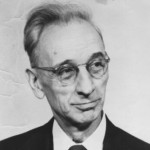
| Birth: | 8th January, 1885 |
| Death: | 11th February, 1967 |
| Nationality: | American |
| Profession: | Clergyman, Politician |
The Reverend Abraham Johannes Muste (January 8, 1885 – February 11, 1967) is known for his work in the labor movement, pacifist movement, and the US civil rights movement.
Muste was born in Zierikzee, the Netherlands, and became a naturalized United States citizen in 1896. He attended Hope College, where he was class valedictorian, captain of the basketball team, and a member of the college's Fraternal Society (Omicron Kappa Epsilon). He earned a Bachelor's degree (A. B.) in 1905 and a Master's degree (M. A.) in 1909 from the Theological Seminary of the Dutch Reformed Church (now the New Brunswick Theological Seminary). He earned a bachelor of divinity (B. D.) from Union Theological Seminary in 1913. He also attended New York University, and Columbia University.
Muste taught Latin and Greek at Northwestern Classical Academy (now Northwestern College) in Iowa from 1905 to 1906. He was ordained a minister of the Reformed Church in America in 1909. Muste served as minister of the Fort Washington Collegiate Church on Washington Heights from 1909 until 1914 when he left the Reformed Church because he no longer ascribed to the Westminster confession. He then became minister of Central Congregational Church, Newtonville MA on February 23, 1915. On Easter Sunday, March 31, 1918, he preached there on the futility of war shortly after one of the prominent sons of the church had been killed in World War I. The congregation called a congregational meeting following the service and terminated Rev. Muste. He and his family had to move out of the church parsonage that very afternoon. He was famously quoted in his saying that, "There is no way to peace—peace is the way." He joined the Fellowship of Reconciliation shortly after its founding.
Muste volunteered for the American Civil Liberties Union and was enrolled as a minister of the Religious Society of Friends in 1918. Active in labor affairs from 1919, he was general secretary of the Amalgamated Textile Workers of America from 1920 to 1921. He also taught at Brookwood Labor College from 1921 to 1933.
After leaving Brookwood Labor College, he founded a socialist movement which, through a fusion with the Trotskyist organisation, became the Workers' Party of the United States. During this period he did not consider himself a pacifist. In 1936 he again became a Christian pacifist.
From 1940 to 1953, he was the executive director of the Fellowship of Reconciliation, during which time he became an advisor to James Lawson and Martin Luther King Jr. He was the author of Non-violence in an Aggressive World (1940).
He supported the presidential candidacies of Eugene V. Debs and Robert M. La Follette, Sr., and also had close friendships with John Dewey and Norman Thomas. His support for civil liberties led him to oppose McCarthyism during the Cold War, which led to false accusations that he was a communist. His writings after 1936 are deeply critical of non-pacifist communism.
In 1956, he and David Dellinger founded Liberation, as a forum for the pacifist and anti-war left.
In 1957, Muste headed a delegation of pacifist and democratic observers to the 16th National Convention of the Communist Party. He was also on the national committee of the War Resisters League (WRL) and received their Peace Award in 1958. Always a creative activist, he led public opposition with Dorothy Day to civil defense activities in New York City during the 1950s and 1960s.
At the end of his life, Muste took a leadership role in the movement against the Vietnam War. According to legend, Muste stood outside the White House every night during the Vietnam War, holding a candle, regardless of whether it was raining or not. In fact he worked many a day and night during the last two years of his life building a coalition of anti-war groups that organized massive protests against the war.
In 1966, Muste traveled with members of the Committee for Non-Violent Action to Saigon and Hanoi. He was arrested and deported from South Vietnam, but received a warm welcome in North Vietnam from Ho Chi Minh.
Related Authors
Advertisement
Today's Anniversary - 20th May
Births
- 1944 - John Robert Cocker
- 1908 - James Stewart
- 1978 - Sasha Azevedo
- 1952 - Walter Isaacson
- 1913 - William Reddington Hewlett
Deaths
- 1831 - Henri Gregoire
- 1986 - Helen B. Taussig
- 1989 - Gilda Radner
- 2005 - Paul Ricoeur
- 1782 - William Emerson
Quote of the day
Popular Topics
Advertisement
About Quoteswave
Our mission is to motivate, boost self confiedence and inspire people to Love life, live life and surf life with words.

Share with your friends